Ask five engineers what they like about aluminum 5052 and you will hear five slightly different answers: it bends without cracking, it shrugs off salt spray, it welds cleanly, and it keeps its strength when a part vibrates for years. Ask those same engineers to quote the numbers, and the conversation slows down, because aluminum 5052 properties are not one fixed set of figures. They move with temper, thickness and product form.
This guide gathers the values that matter most, explains what they mean on the shop floor, and shows where 5052 stands next to the alloys designers usually compare it with. Whether you are specifying a fuel tank, a marine panel or an electrical enclosure, the goal is the same: choose the alloy and the form that let the part do its job without over-engineering it.
Content
5052 belongs to the 5xxx family, the aluminum-magnesium alloys. It is not heat-treatable, which means it gains strength through cold work rather than through solution treatment and aging. Two elements do most of the work: magnesium, which raises strength and corrosion resistance, and chromium, which refines the grain structure and helps the alloy resist stress corrosion cracking.
Typical composition limits for the alloy are:
Because it cannot be strengthened by heat treatment, 5052 is supplied in O (annealed) and H tempers. In an H temper such as H32, H34, H36 or H38, the metal is strain hardened by rolling and then stabilized with a low-temperature treatment so it will not continue to age on the shelf. The digit after the H tells you roughly how much cold work went in, and therefore how much strength you gain and how much ductility you give up.
The table below lists typical room-temperature values for 5052 sheet. Treat them as a design starting point rather than a guarantee: heavier gauges, different product forms and normal mill-to-mill variation all shift the numbers a little, and your supplier's certified test report is always the final word.
| Temper | Tensile strength (MPa) | Yield strength (MPa) | Elongation (%) | Hardness (HB) |
|---|---|---|---|---|
| O (annealed) | 195 | 90 | 25 | 47 |
| H32 | 228 | 193 | 12 | 60 |
| H34 | 262 | 214 | 10 | 68 |
| H36 | 276 | 241 | 8 | 73 |
| H38 | 290 | 255 | 7 | 77 |
Read the table as a trade-off curve. Moving from O to H38 buys you roughly 50% more tensile strength, but elongation falls from about 25% to about 7%, which is the difference between a part you can form freely and one you must form gently. Its modulus of elasticity stays close to 70 GPa in every temper, so stiffness does not improve with cold work. Published fatigue endurance limits for H32 sheet sit in the region of 110-120 MPa at 5 x 10^8 cycles, which is one reason 5052 shows up in parts that see vibration rather than static load.
The physical values are stable across tempers and are usually the first numbers a weight or thermal calculation needs:
Compared with 6061 at 2.70 g/cm³, 5052 is slightly lighter, which matters more in a large panel or a long run of sheet than in a small bracket. Its thermal conductivity is lower than that of extrusion alloys such as 6063, so where heat transfer is the primary function, engineers often weigh the two carefully. Even so, 5052 remains a common material for brazed cooling cores and heat-exchanger plates, because it combines reasonable conductivity with excellent formability and resistance to wet corrosion.
5052 earned much of its reputation in wet, salty places. In seawater and salt-spray exposure it generally outperforms 6061, and it resists the pitting and stress corrosion cracking that shorten the life of other alloys in marine service. That is why it turns up in boat hulls, fuel tanks, pontoon structures and dock hardware.
It is also one of the more forgiving aluminum alloys to weld. TIG and MIG both work well, with 5356 filler typically recommended for 5052 base metal, and resistance welding is widely used for sheet assemblies. The one caution is the heat-affected zone: welding softens the metal beside the joint, so on pressure vessels and load-bearing parts it is better to allow for locally reduced strength than to assume the parent-metal figures hold everywhere. Anodizing is another point worth planning for. 5052 anodizes reliably, but the finish usually reads a little duller and slightly grayer than the bright, clear coating associated with 6061 or 6063, which is why decorative trim often goes a different route.
No, and this is one of the most common misunderstandings about the alloy. Unlike 6061 or 6063, 5052 cannot be strengthened by solution treatment and aging. Heat it and it gets softer, not harder. Three practical consequences follow.
Designers rarely look at 5052 in isolation. The comparison usually comes down to 6061, the general-purpose heat-treatable alloy, and 6063, the extrusion standard.
| Alloy and temper | Heat treatable | Typical tensile strength (MPa) | Density (g/cm³) | Marine corrosion resistance | Machinability | Forming or extruding |
|---|---|---|---|---|---|---|
| 5052-H32 | No | 228 | 2.68 | Excellent | Fair | Excellent forming |
| 6061-T6 | Yes | 310 | 2.70 | Good | Good | Fair forming |
| 6063-T6 | Yes | 241 | 2.70 | Good | Good | Excellent extruding |
6061-T6 is stronger and machines far more cleanly, but it is harder to bend and loses more strength in the heat-affected zone after welding. 6063-T6 extrudes into complex shapes with a fine surface finish, which is why it dominates architectural and structural profiles. 5052 wins when the part is formed, welded and exposed to moisture, and when a slightly lighter sheet is welcome.
Crash management shows how quickly the decision can leave the sheet-metal world altogether. Energy-absorbing crash boxes and bumper beams are almost always extruded from 6xxx or 7xxx alloys, because extrusion gives the designer the wall thickness, internal ribs and predictable collapse behaviour the application demands. 5052 sheet has no real role there.
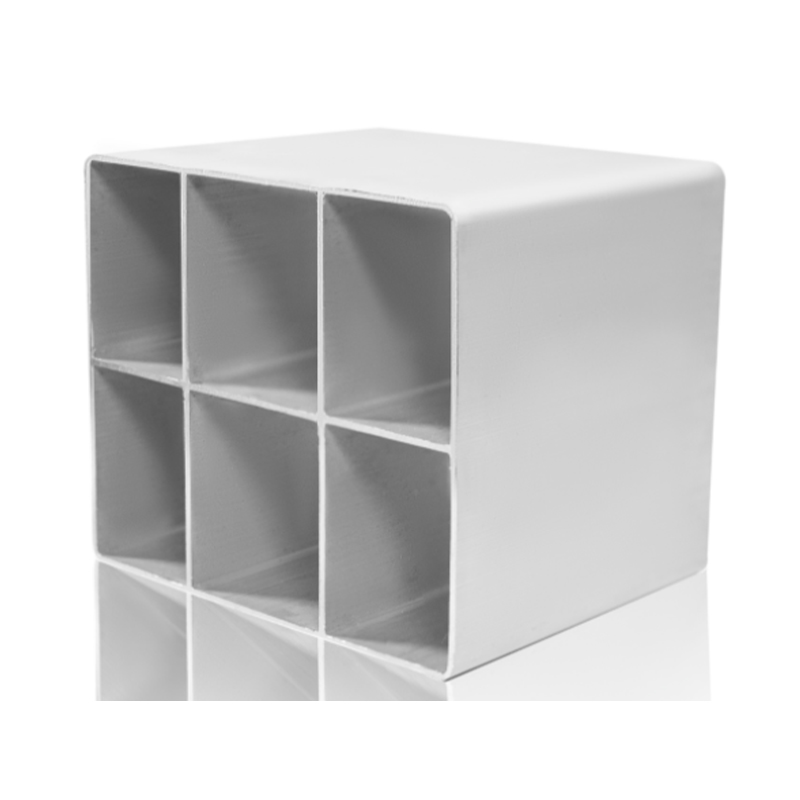 Automotive Crash Box Aluminum Profiles for Impact Energy AbsorptionExtruded 6xxx/7xxx alloy profiles for vehicle front and rear crash protection, offering lightweight energy absorption through controlled deformation.View Product →
The applications list is long, but it clusters around a few themes: formed parts that live outdoors, welded assemblies that must hold liquids, and components that see vibration. Typical uses include fuel tanks and fuel lines, marine hulls and deck components, pressure vessels and chemical storage, heat-exchanger cores, truck, trailer and RV body panels, signage and architectural cladding, appliance and electrical enclosures, and rivets and fasteners.
Electric vehicles have added a new chapter. Battery enclosure covers, cold plates and underbody shields are often specified in 5052 sheet because it forms well, conducts heat reasonably and resists road-salt corrosion. The structural tray underneath is a different story: it is usually an extruded profile, where wall thickness and integrated features can be controlled along the length of the part. We covered that split in more detail in our guide to EV aluminum structures and lightweight vehicle parts, and it is a useful reminder that sheet and extrusion often solve two halves of the same design problem.
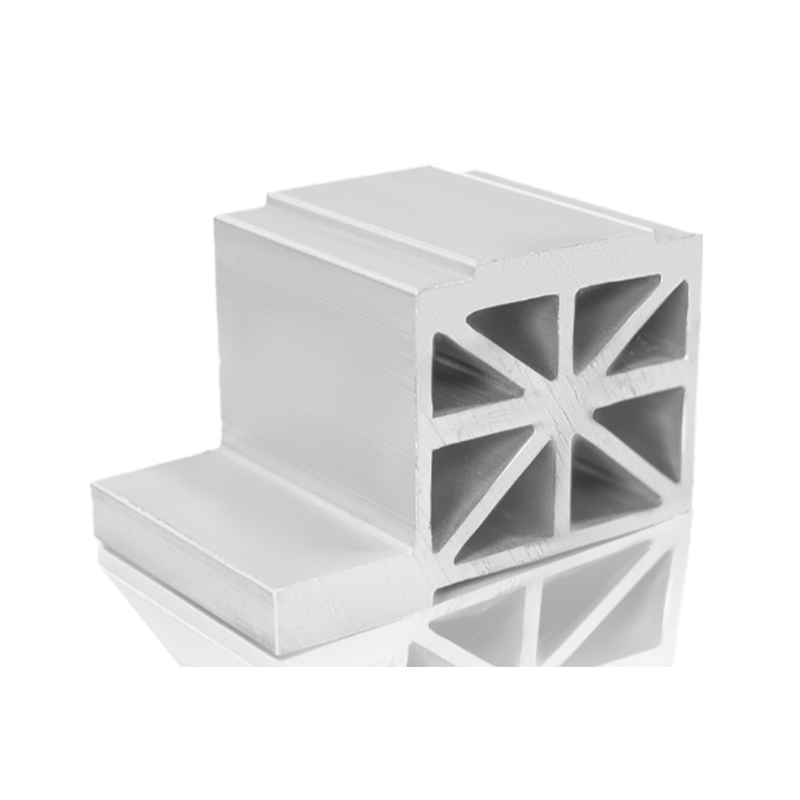 Battery Tray Aluminum Profiles for New Energy VehiclesHigh-strength extruded profiles for new energy vehicle battery trays, providing structural support and heat dissipation while supporting safety and driving-range goals.View Product →
Forming is where 5052 feels at home. H32 sheet will take a tight bend, commonly in the range of one to two times the material thickness, where 6061-T6 tends to crack if you push it. Deep drawing is possible, but the alloy work-hardens quickly, so plan anneals between severe operations.
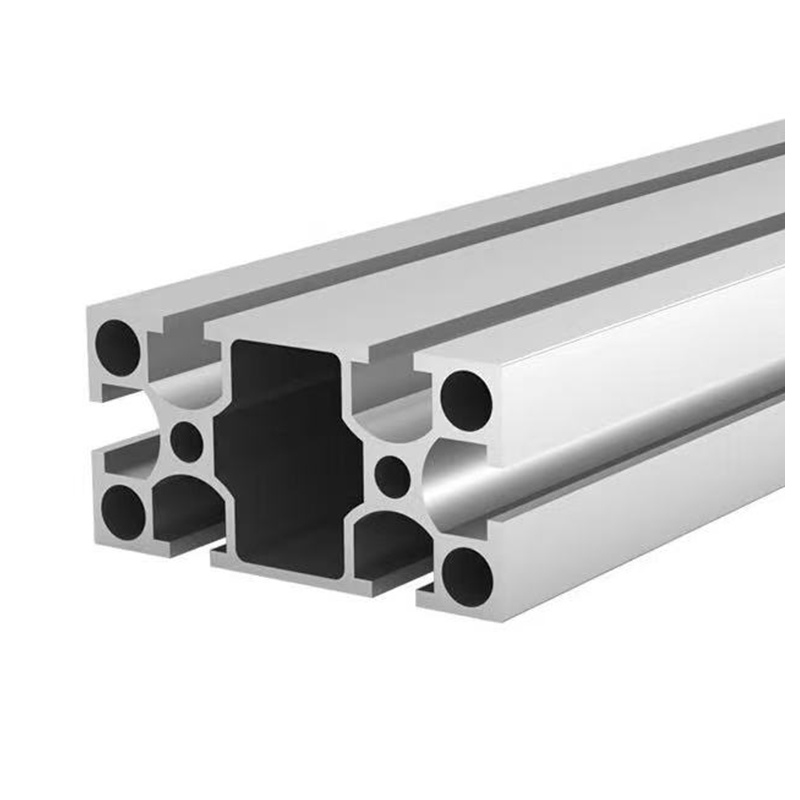
Machining is the weaker side of the alloy's character. It is rated only fair, with soft, gummy chips and a tendency to drag on tooling, which means lower cutting speeds, sharp edges and generous rake compared with 6061. Anodized finishes are also less bright than on 6xxx alloys. If a project needs a rigid frame rather than a formed panel, extruded profiles cut cleaner and assemble faster than welded sheet, which is why T-slot systems are so common in automation and equipment building.
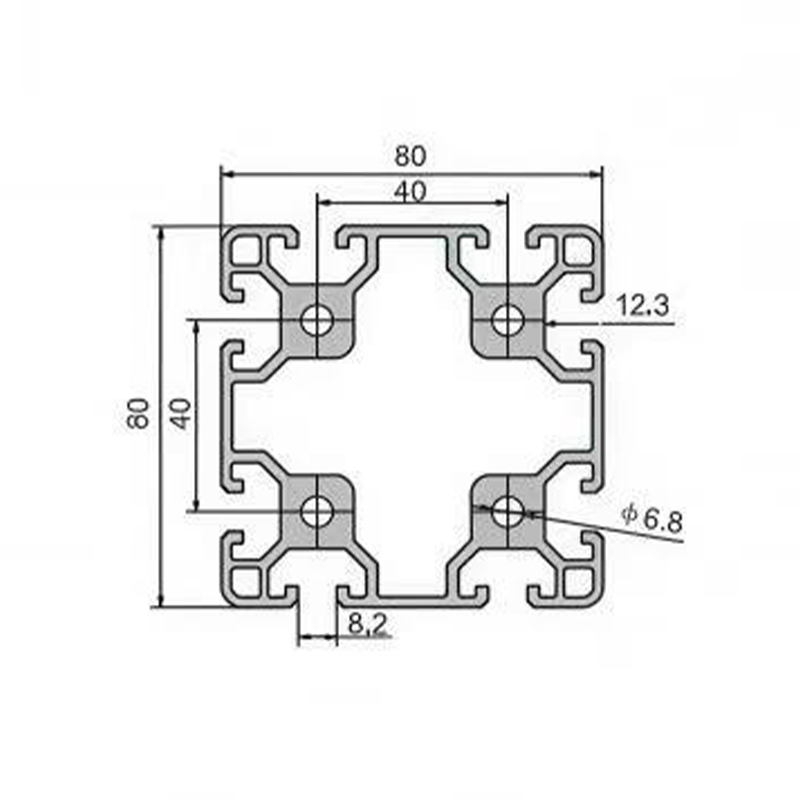 Modular Assembly Line Aluminum Profiles for Industrial AutomationReusable extruded profiles for assembly lines, workbenches, and automation frames, supporting quick assembly, adjustment, and expansion with high load-bearing capacity.View Product →
If the part is flat, formed, welded and exposed to moisture, 5052 sheet is usually the right answer, and H32 is the sensible starting temper. If the part is long with a constant cross-section, needs stiffness, tight tolerance machining or a bright anodized finish, an extruded 6xxx profile will almost always be faster and cheaper to produce.
As a manufacturer working in building, photovoltaic and industrial aluminum profiles, we spend a lot of time in that second category, including the lightweight automotive parts where extrusion does what sheet cannot. If you are weighing a 5052 sheet design against an extruded one, the comparison is worth having early, while the geometry is still flexible. You can see the range of parts we produce in our automotive lightweight aluminum profiles line, and we are happy to talk through which route suits your part.
 +86-19156366875
 No. 1016, Baocheng Road, Economic and Technological Development Zone, Xuancheng City, Anhui Province, China
Copyright © Anhui Huilong Group Huilv New Material Technology Co., Ltd. All Rights Reserved
Aluminum Profiles Manufacturers