Aluminum balcony railings have become one of the most widely specified products in residential and commercial construction, thanks to their corrosion resistance, low maintenance requirements, and design flexibility. But choosing the right profile style is not simply an aesthetic decision — it directly affects structural performance, installation complexity, cost, and long-term durability. The three dominant profile styles used in aluminum balcony railings are flat bar profiles, round tube profiles, and square tube profiles. Each carries its own engineering characteristics, visual identity, and ideal application context. Understanding the differences in detail helps architects, contractors, and homeowners make informed decisions from the outset.
Content
Flat bar aluminum profiles are rectangular in cross-section with a notably wide, thin form — typically ranging from 25mm to 80mm in width and 3mm to 10mm in thickness. This geometry makes them visually unobtrusive, which is why flat bar profiles dominate contemporary architectural projects where the railing should complement the structure without commanding attention.
The slim profile allows maximum light transmission and unobstructed views, making flat bar railings a popular choice for balconies overlooking water, gardens, or urban skylines. When oriented horizontally as infill bars, they create a clean, stacked appearance that pairs well with glass panels or cable systems. When used vertically as balusters, they produce a refined, fence-like aesthetic that suits both residential terraces and commercial façades.
Flat bar profiles perform well under vertical loads but have reduced resistance to lateral bending along their narrow axis. This means spacing and post intervals must be carefully calculated by structural engineers, especially for balconies exposed to high wind loads. Most building codes require balcony railings to withstand a horizontal force of at least 0.74 kN/m (approximately 50 lbf/ft). With flat bars, achieving this typically requires closer post spacing — commonly 900mm to 1200mm — compared to tube profiles.
Flat bar profiles are frequently extruded in 6061-T6 or 6063-T5 aluminum alloys. The 6063 series, in particular, offers excellent surface finish quality after anodizing, making it the preferred choice when visual appearance is a primary requirement.
Round tube aluminum profiles are circular hollow sections available in a wide range of diameters, from 25mm handrail inserts up to 76mm or larger structural posts. The circular cross-section distributes stress evenly in all directions, which gives round tubes excellent resistance to bending and torsion regardless of load angle. This isotropic strength makes round tube profiles one of the most structurally efficient options available for balcony railing systems.
Aesthetically, round tubes carry a classic, versatile character. They are equally at home in traditional wrought-iron-inspired designs, mid-century modern settings, and contemporary marine applications. Their smooth, continuous surface is easy to grip, which is why round profiles are the default choice for handrails and top rails in public and commercial buildings where ergonomics and safety standards must be met.
Standard round tube diameters and their typical applications are outlined below:
| Outer Diameter | Wall Thickness | Typical Application |
|---|---|---|
| 25mm – 32mm | 1.5mm – 2.0mm | Baluster infill, decorative inserts |
| 38mm – 50mm | 2.0mm – 3.0mm | Handrails, top rails |
| 60mm – 76mm | 3.0mm – 4.0mm | Structural posts, newel posts |
One practical advantage of round tube profiles is the wide availability of compatible fittings — elbows, end caps, flanges, and connectors are standardized across most supplier catalogs. This simplifies procurement and reduces on-site fabrication time. However, joining round tubes to flat surfaces or square components can require custom machining or saddle cuts, which adds labor cost compared to square tube connections.
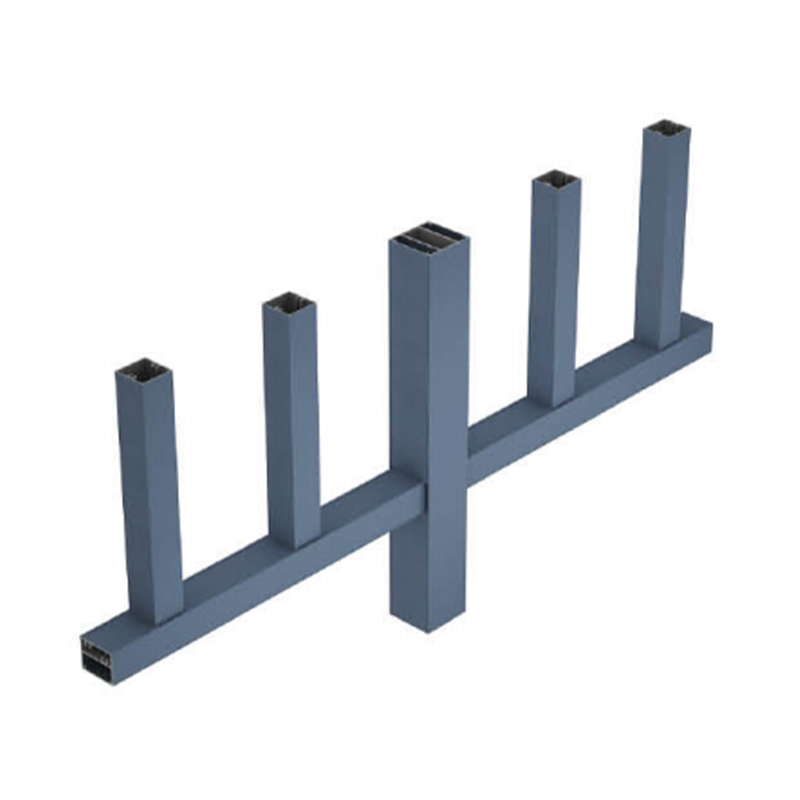
Square tube aluminum profiles — and their close relatives, rectangular hollow sections (RHS) — offer flat mating surfaces on all four sides, which significantly simplifies welding, bolting, and bracket attachment. This geometric property makes square tubes the preferred choice for contractors who prioritize fabrication speed and precision alignment on-site. Mitered joints sit flush, connections are straightforward, and integration with flat-plate base flanges requires no special profiling.
Common square tube sizes for balcony railing systems range from 25×25mm to 100×100mm, with wall thicknesses between 1.5mm and 5mm. For structural posts, 50×50mm and 60×60mm sections with 3mm walls are widely used because they provide sufficient moment resistance at typical post spacings of 1000mm to 1500mm while remaining lightweight enough for straightforward handling.
Square tube profiles suit a broad range of design languages. Used vertically as balusters at tight spacing, they evoke a louvered screen effect with interesting shadow play throughout the day. Used as horizontal rails, they create a bold, industrial aesthetic that has become popular in loft conversions, rooftop terraces, and commercial hospitality projects. When powder coated in matte black or dark bronze finishes, square tube railings can effectively mimic steel-framed designs at a fraction of the weight and without the corrosion risk.
One consideration with square tube profiles is water drainage. Horizontal square tubes used as bottom rails can trap rainwater and debris if not designed with drainage holes or a slight pitch. Without proper drainage provisions, standing water accelerates oxidation at cut ends and welded joints — the two areas most vulnerable in any aluminum railing system.
Each profile style has a clearly defined performance envelope. The table below summarizes the most relevant comparison points for balcony railing specification:
| Criteria | Flat Bar | Round Tube | Square Tube |
|---|---|---|---|
| Structural Strength | Moderate (directional) | High (omnidirectional) | High (directional) |
| Fabrication Ease | Moderate | Moderate | High |
| Aesthetic Style | Minimalist, modern | Classic, versatile | Industrial, geometric |
| Grip Ergonomics | Low | High | Moderate |
| Water Drainage Risk | Low | Low | Higher (needs detailing) |
| Fitting Availability | Limited | Extensive | Good |
Regardless of profile geometry, aluminum balcony railings require surface treatment to protect cut ends, welded zones, and exposed extrusion surfaces from oxidation and UV degradation. The two primary finishing methods are anodizing and powder coating, each with distinct advantages depending on the profile type and project environment.
Anodizing creates a dense aluminum oxide layer that is fully integrated into the metal surface, making it scratch-resistant and permanent. It is best suited for flat bar and round tube profiles where a natural metallic appearance — typically in silver, champagne, or bronze tones — is desired. Anodized finishes perform exceptionally well in coastal environments, withstanding salt spray without blistering or peeling. Standard anodizing thickness runs from 10 microns (Class 10) for interior use to 25 microns (Class 25) for severe marine exposure.
Powder coating offers a virtually unlimited color palette and is applied uniformly across all profile geometries including the flat inner faces of square tubes. A properly cured thermosetting powder coat — typically 60 to 80 microns dry film thickness — provides excellent impact resistance and UV stability. For square tube profiles where color consistency across flat surfaces and corners is critical, powder coating is the more reliable finishing method compared to liquid paint or anodizing.
The best way to narrow down your profile choice is to evaluate your project against four primary factors: structural load requirements, architectural design intent, installation environment, and budget constraints. These four factors rarely point toward the same profile simultaneously, which is why many real-world railing systems combine profile types — for example, round tube structural posts with flat bar infill balusters, or square tube posts with a round tube top rail for ergonomic gripping.
For coastal or high-humidity environments, prioritize anodized round tube profiles for posts and rails, as their smooth continuous surface resists moisture penetration better than cut-end-exposed flat bars. For high-traffic commercial balconies with strict graspability codes, round tube top rails in the 40mm–50mm diameter range are the compliant default in most jurisdictions. For projects where speed of fabrication and budget control are primary concerns, square tube systems with pre-cut kits and standard bracket hardware offer the fastest path from materials to installed railing.
Ultimately, the profile style you specify will shape both the visual character and the long-term performance of the balcony. Taking time to evaluate each option against specific project demands — rather than defaulting to a single style across all applications — consistently produces better outcomes in durability, code compliance, and design quality.
 +86-19156366875
 No. 1016, Baocheng Road, Economic and Technological Development Zone, Xuancheng City, Anhui Province, China
Copyright © Anhui Huilong Group Huilv New Material Technology Co., Ltd. All Rights Reserved
Aluminum Profiles Manufacturers