Content
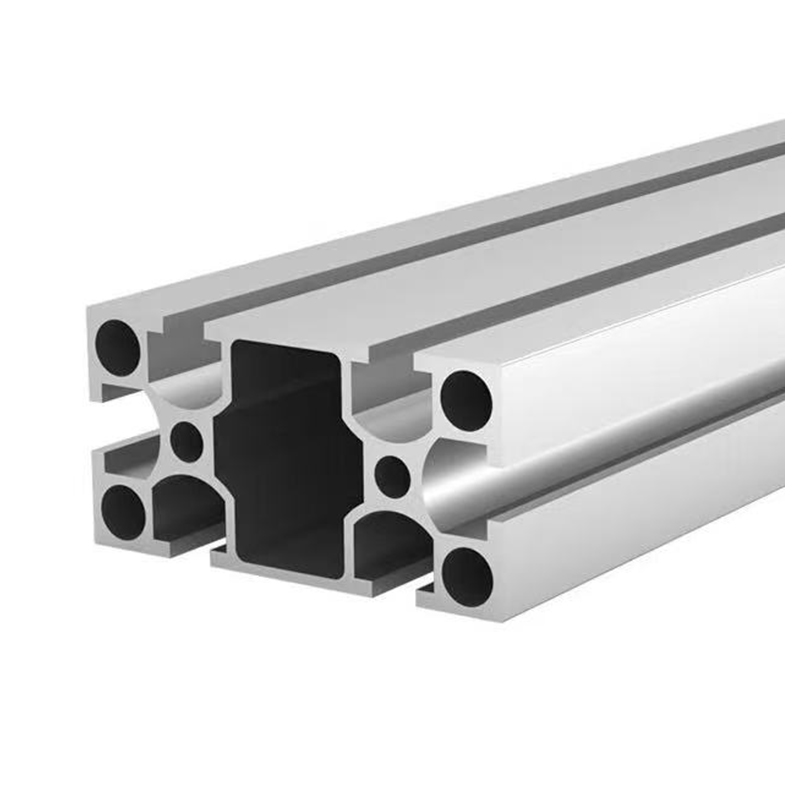
For most machine bases, workstations, guards, enclosures, carts, and light industrial structures, aluminum frame systems built from structural aluminum extrusion offer the best balance of strength, flexibility, weight, and assembly speed. They are especially effective when a structure may need to be expanded, reconfigured, repaired, or moved later.
The main reason is simple: structural aluminum extrusion turns the frame into a modular building system. Profiles can be cut to length, joined with standardized connectors, and fitted with panels, doors, shelves, cable routing, guards, or linear components without welding. That lowers fabrication time and reduces the cost of design changes.
This does not mean every profile works for every load. Aluminum is much lighter than steel, but it is also less stiff, so profile size, span, and connection design matter. In practice, a well-designed aluminum frame system performs best when the engineer checks load paths, controls deflection, reinforces joints, and chooses profile geometry based on the actual duty cycle rather than just the static weight.
Structural aluminum extrusion is widely used because it solves several design problems at the same time. It provides usable strength, low mass, corrosion resistance, clean appearance, and fast assembly in one material system.
Aluminum has a density of about 2.7 g/cm³, while carbon steel is about 7.85 g/cm³. By volume, aluminum is roughly one-third the weight of steel. In real projects, that can reduce shipping weight, make assembly safer, and lower the load placed on floors, casters, suspended supports, or moving axes.
One of the biggest advantages of aluminum frame systems is the slot itself. Panels, sensors, brackets, hinges, cable clips, and guards can be mounted directly to the profile. That removes the need for repeated drilling and welding, and it turns future changes into a simple mechanical task instead of a full rebuild.
Aluminum naturally forms an oxide layer that protects the surface in many indoor and moderately corrosive environments. For factory automation, laboratory equipment, assembly stations, and clean production spaces, this often makes the frame easier to maintain than painted carbon steel.
A welded steel frame may require cutting, fixturing, welding, grinding, coating, and post-machining. A structural aluminum extrusion frame normally requires cutting, connector installation, squaring, and tightening. On projects with frequent revisions, the time saved during assembly and rework is often more valuable than the raw material difference.
When selecting an aluminum frame system, many people focus first on whether the frame can hold the load without yielding. In practice, the more important question is often whether the frame will deflect too much during normal use. A machine stand can be technically strong enough and still perform poorly if it vibrates, twists, or sags.
Elastic modulus is a useful reminder here. Aluminum is about 69 GPa, while steel is about 200 GPa. That means aluminum is less stiff for the same cross-sectional shape. The usual solution is not to avoid aluminum, but to use smarter geometry: larger profiles, shorter unsupported spans, diagonal bracing, better joint reinforcement, and direct load transfer into vertical members.
A practical example shows why geometry matters. In a simply supported beam with a center load, doubling the member’s second moment of area roughly cuts deflection in half under the same load and span. That is why a deeper or better-braced profile can outperform a smaller section even if both use the same alloy.
The right profile family depends on load, span, motion, environment, and how often the structure will change. Instead of choosing by appearance alone, it is better to match the frame to the application type.
If a frame supports static shelving, moderate deflection may be acceptable. If it supports a vision system, a sliding mechanism, or a precise assembly fixture, the frame should be much stiffer. A short span carrying a centered load behaves very differently from a long span with torsion, off-axis force, or vibration.
Hidden end fasteners may create a clean look, but external corner brackets or gusset plates often provide better resistance to racking. For larger systems, the connector choice can change frame stiffness more than small changes in profile wall thickness.
If the structure will gain more accessories, guards, cables, pneumatics, or equipment over time, leave spare slot access and reserve room for additional bracing. One advantage of structural aluminum extrusion is that expansion is easy, but only if the original layout allows it.
The table below shows how aluminum frame systems are usually prioritized in different applications. The exact profile dimensions vary by design standard, but the selection logic stays consistent.
| Application | Primary Priority | Recommended Design Focus | Common Risk |
|---|---|---|---|
| Workstations and benches | Ergonomics and modularity | Accessory slots, shelf support, leveling feet | Undersized top spans |
| Machine guards and enclosures | Panel integration and rigidity | Door alignment, corner squareness, anchor points | Racking at door openings |
| Carts and mobile frames | Low weight and impact resistance | Caster plates, corner reinforcement, low center of gravity | Joint loosening under motion |
| Automation frames | Stiffness and repeatability | Short spans, gussets, vibration control | Deflection affecting accuracy |
| Platforms and support stands | Load transfer and safety margin | Larger columns, bracing, base anchoring | Lateral sway |
Profiles matter, but joints are where performance is often won or lost. Two frames built from the same structural aluminum extrusion can behave very differently depending on how they are connected and supported.
External brackets increase the effective joint footprint and make it easier to resist sideways deformation. They are especially useful around doors, cantilevered shelves, and moving equipment.
A tall frame with narrow depth can become unstable even if each member is strong enough individually. Base plates, anchors, and wider support geometry reduce overturning risk and improve operator confidence when doors or drawers are opened.
If a frame sways, adding material blindly is not always the most efficient solution. A well-placed diagonal brace or shear panel can raise lateral stiffness dramatically with little added weight. This is often the fastest way to improve an aluminum frame system that feels too flexible in service.
Consider a production workstation with a clear span of 1500 mm supporting tools, bins, and a work surface. The total vertical service load might be 800 to 1200 N, but the designer also has to account for operators leaning on the bench, drawers opening, and occasional impact from loaded trays.
If the top frame uses a light profile with no intermediate support, it may remain below yield stress and still show noticeable sag. The better solution is usually to use a deeper horizontal member, add an intermediate rail under the work surface, and direct load into vertical legs close to the heaviest tools. That approach reduces bending length and makes the station feel much more stable.
The same logic applies to machine enclosures. A door opening removes structural continuity, so the frame around that opening needs stronger jointing and often a deeper lintel profile. Otherwise, the door may bind over time even if the overall frame still appears square.
Many disappointing results come from predictable design shortcuts rather than from the material itself. Aluminum frame systems perform well when they are treated as engineered structures instead of as generic kit parts.
A useful rule is that every frame should be checked in the condition it will actually see in service, not just in its empty or idealized state. A cart is not only a static frame; it is also a moving structure with shock, torsion, and repeated connector loading. A workstation is not only a tabletop support; it is also a human interface subject to eccentric loading.
One of the strongest arguments for structural aluminum extrusion is that it remains serviceable after installation. Frames can be disassembled, extended, or upgraded without cutting apart welded joints. That lowers the lifecycle cost of change.
Good installation practice still matters. Profiles should be cut square, connectors tightened to consistent torque, frames assembled on a flat reference surface, and diagonals checked before final tightening. These steps reduce residual twist and help doors, panels, and accessories align correctly from the start.
Maintenance is usually straightforward: inspect critical joints, recheck hardware in mobile or vibrating applications, confirm anchors remain tight, and keep slots clear where accessories may need to be added. In many facilities, the ability to modify the structure without repainting, rewelding, or shutting down fabrication tools is a major operational advantage.
Aluminum frame systems and structural aluminum extrusion are most effective when the project needs modularity, clean assembly, low weight, and reliable structural performance with future flexibility. They are not just convenient framing products; they are a practical structural system for industrial and technical applications.
The best results come from focusing on stiffness, span control, joint design, and realistic service loads. When those factors are handled well, aluminum frames deliver fast installation, easy expansion, and long-term usability in a way that few other framing methods can match.
 +86-19156366875
 No. 1016, Baocheng Road, Economic and Technological Development Zone, Xuancheng City, Anhui Province, China
Copyright © Anhui Huilong Group Huilv New Material Technology Co., Ltd. All Rights Reserved
Aluminum Profiles Manufacturers